Robot Fleet Monitoring: How Teams Track Robot Health and Performance
Developing a single robot in a laboratory is a great engineering milestone. The machine navigates clean floors, avoids test markers, and never runs low on power while tethered to a bench supply.
However, operating dozens or hundreds of robots in an active facility creates entirely new problems.
In production, machines face spotty wireless connectivity, mismatched software versions, and degrading batteries. Sensor lenses collect grime, drive motors heat up, and navigation failures block busy aisles. When machines stop working in the field, teams need clear operational systems. They must collect telemetry, inspect logs, deploy software updates remotely, and schedule physical maintenance without halting daily work.
RobotOps organizes these operational activities into a clear, repeatable discipline. It brings development and operational practices together to keep robotic systems dependable in real-world environments.
What Is RobotOps?
RobotOps is the practice of applying software engineering, DevOps, automation, monitoring, testing, and lifecycle-management methods to robotic systems.
Rather than viewing a robot as a finished hardware product, RobotOps treats it as a connected edge system. It links multiple technical areas:
Robotics + Software Engineering + DevOps + Automation + Observability + Operations
Robotics provides physical mechanics, sensors, and motion control. Software engineering delivers modular application code and automated tests. DevOps and operations provide continuous delivery pipelines, monitoring, and fleet management.
RobotOps covers the complete operational lifecycle of a robot. It manages software from the first line of code through testing, deployment, field monitoring, and retirement.
Why Robotics Operations Need a Different Approach
Operating robotic systems differs significantly from operating ordinary software applications.
In traditional cloud computing, an application runs inside a climate-controlled data center. If a web service crashes, an automated script restarts the container in seconds. No physical damage occurs, and end users rarely notice more than a momentary delay.
Robots interact directly with the physical world. Operational failures often involve software and physical hardware at the same time:
Physical hardware: Drive motors heat up, wheel treads wear down, and mechanical joints loosen over time.
Sensors: Cameras collect dust, lidars experience optical glare, and depth sensors struggle in direct sunlight.
Motors and controllers: Microcontrollers and motor drivers face mechanical vibration and electrical noise.
Network connectivity: Concrete pillars, metal racks, and wide floor plans create dead zones that drop wireless connections.
Battery levels: Power drains under heavy loads. If a robot cannot reach a charger, it halts wherever it stands.
Physical environments: Workers walk into transit lanes, boxes fall, and floor surfaces change from slick tile to rough concrete.
Safety requirements: A software bug in a cloud service returns an error log. A software bug on a 150-kilogram mobile robot can strike machinery, damage goods, or injure workers.
Software and firmware versions: Onboard systems run multiple layers of code, from low-level motor firmware to high-level path planners.
Real-world failures: A small mechanical jam can look like a navigation software failure.
Because of these dependencies, software-only operational practices are not enough for robotic environments. Operations teams must understand both the code and the physical machine.
RobotOps vs DevOps
RobotOps builds directly on DevOps principles. Both models value version control, continuous integration, automated testing, staged rollouts, and active monitoring.
However, RobotOps extends these concepts into physical spaces where machines move and conditions change.
| Area | DevOps | RobotOps |
| Main focus | Software systems | Software and robotic systems |
| Deployment | Applications and services | Robot software, configurations, and updates |
| Monitoring | Servers, applications, infrastructure | Robots, telemetry, sensors, software, and fleet health |
| Testing | Software and infrastructure | Software, simulation, hardware behavior, and robot workflows |
| Failures | Application or infrastructure failures | Software, hardware, network, navigation, and physical failures |
| Operations | IT environments | Physical and software-based robotic environments |
The main difference comes down to the operating environment. DevOps assumes computing hardware is stationary, protected, and continuously connected. RobotOps assumes target machines are mobile, intermittently disconnected, and subject to physical wear and tear.
Robot Fleet Management
Robot Fleet Management is the practice of tracking and coordinating multiple robots across one or more facilities.
Managing one robot can often be done manually. An engineer can walk over to a stopped unit, connect a debug cable, inspect terminal logs, and swap batteries by hand.
When an organization runs dozens or hundreds of robots, manual oversight is impossible. Centralized fleet management software provides operational control over:
Robot health: Component fault codes, motor temperatures, and supply voltages.
Location: Showing real-time positions on facility map overlays.
Battery: Tracking state of charge, discharge rates, and charging dock availability.
Connectivity: Monitoring Wi-Fi signal strength and packet loss across different facility zones.
Software version: Verifying running application versions and configuration parameters across units.
Task status: Assigning jobs to the nearest available machine with sufficient battery power.
Telemetry: Streaming operational health signals to central dashboards.
Alerts: Raising immediate flags when a unit stops moving or encounters an obstacle.
Remote operations: Allowing support engineers to safely inspect stopped machines.
Maintenance: Scheduling physical upkeep and tracking runtime hours on mechanical components.
Software updates: Scheduling and distributing over-the-air software updates.
In a warehouse, for example, a fleet manager coordinates fifty autonomous mobile robots moving pallets. If one unit reports high motor temperatures while carrying a load, the fleet system reassigns the job to a nearby robot and directs the hot unit to a cooling area. Centralized visibility prevents traffic bottlenecks and avoids operational downtime.
Robotics Operations Center
A Robotics Operations Center (ROC) acts as the central operational system for a robotics deployment.
A ROC does not have to be a physical room with wall-mounted screens. For many engineering teams, a ROC is a secure software platform that brings together dashboards, telemetry streams, and remote management tools into one interface.
An operations center typically provides visibility into:
Fleet dashboards: High-level views of active, charging, idle, and faulted units.
Logs: Aggregating runtime logs for post-incident reviews.
Metrics: Tracking task completion times, distance traveled, and error rates.
Telemetry: Streaming real-time speed, battery, and diagnostic data.
Alerts: Routing urgent issues to on-call technicians while filtering minor noise.
Deployment status: Monitoring software rollout progress across site groups.
Software versions: Tracking which software packages are installed on each unit.
Incidents: Managing open support tickets and hardware repair workflows.
Maintenance: Scheduling mechanical inspections based on operating hours.
Remote operations: Allowing technicians to safely inspect sensor feeds and run diagnostic checks.
Centralized visibility helps teams identify and respond to problems faster before small anomalies turn into facility-wide shutdowns.
Robotics Software and ROS 2
Robotics software controls everything from low-level motor drivers to high-level motion planning. In modern robotics, a large portion of the community builds applications using ROS 2 (Robot Operating System).
ROS 2 is not an operating system in the traditional sense like Linux. It is a modular software framework and middleware layer that lets different programs inside a robot communicate with each other.
Key ROS 2 building blocks include:
Nodes: Small, single-purpose executable programs. One node reads camera frames, another runs motor controls, and a third calculates navigation paths.
Topics: Data buses over which nodes publish and subscribe to continuous data streams, such as sensor feeds.
Messages: Standardized data structures sent over topics.
Services: Request-and-response mechanisms used for quick state checks.
Actions: Goal-oriented communication for longer tasks that provide continuous progress feedback.
Middleware: An underlying Data Distribution Service (DDS) layer that routes messages between nodes.
Understanding these concepts helps RobotOps engineers manage production systems. ROS 2-based systems become part of an operational workflow where teams must package nodes into containers, manage configuration files, monitor communication latency, and collect node logs during unexpected stops.
Robot Simulation
Testing software updates directly on physical hardware can be slow, costly, and hazardous. If an obstacle-avoidance algorithm has a bug, testing it on a physical robot could drive a steel chassis into a conveyor belt.
Robot simulation provides a safe, virtual environment to test code changes before touching physical machines.
Simulation helps engineers in several ways:
Test navigation: Check how path planners handle narrow doorways, tight turns, or crowded corridors.
Reproduce failures: Replay sensor logs from a field failure inside a virtual world to find the root cause.
Try unusual conditions: Simulate extreme edge cases, like sudden sensor outages or slippery floors, without physical danger.
Validate behavior: Confirm that a robot yields to obstacles correctly before deploying updates.
Test software before physical deployment: Run automated regression suites against new software builds.
Reduce unnecessary physical testing: Catch obvious logic bugs in software before taking machines off the warehouse floor.
Simulation reduces testing risks and catches obvious bugs early. However, simulation does not replace every form of physical testing. Virtual models cannot fully reproduce subtle floor traction changes, dirty lenses, or mechanical wear. Physical validation on staging units remains essential.
Monitoring and Observability
To run robots reliably, teams need deep visibility into system behavior.
Basic monitoring tracks known metrics against fixed thresholds. Deeper observability allows engineers to understand why an unexpected state occurred by analyzing multiple operational signals together.
Useful metrics include:
Battery level: Tracking discharge rates and cell health.
CPU and memory usage: Ensuring onboard computers do not run out of resources.
Temperature: Watching drive motors, onboard computers, and battery packs.
Network health: Monitoring Wi-Fi signal strength, packet drop rates, and latency.
Navigation failures: Tracking path computation timeouts, localization errors, and unexpected stops.
Task completion: Measuring job durations, idle times, and aborted tasks.
Latency: Checking communication delays between sensors and motor controllers.
Error rates: Counting sensor dropouts and node restarts.
Effective observability relies on four primary components:
Metrics: Numeric values tracked over time to show trends.
Logs: Time-stamped text records describing events leading up to a fault.
Alerts: Automated notifications that fire when critical thresholds are crossed.
Telemetry: Continuous streams of operational health data sent from robots to central servers.
These signals help engineers identify problems before they become larger operational issues.
Robotics Automation
Manual maintenance does not scale. If a technician must manually connect a cable to update every machine, maintaining fifty robots consumes entire workweeks.
Robotics automation applies repeatable scripts and automated pipelines to common operational tasks:
Robot provisioning: Automatically installing operating systems, network certificates, and dependencies on new onboard computers.
Software deployment: Building container images and pushing them to target units over the air.
Configuration updates: Syncing updated site maps and parameter files across the fleet.
Health checks: Running automated diagnostic checks on motors, sensors, and brakes before a shift starts.
Log collection: Automatically uploading crash logs and sensor recordings when a robot halts.
Automated testing: Running regression tests in simulation whenever developers commit new code.
Fleet updates: Rolling out software patches in controlled, staged groups.
Recovery workflows: Safely restarting frozen navigation nodes without rebooting the entire machine.
Automation should always operate within proper safety controls. Critical updates and physical resets should include human oversight.
Autonomous Mobile Robots
Autonomous Mobile Robots (AMRs) represent one of the most common commercial uses of RobotOps. These machines move goods inside warehouses, factories, logistics facilities, and distribution centers.
Operating an AMR fleet introduces specific daily concerns:
Navigation: AMRs must steer around dynamic obstacles, yield to workers, and plan safe routes.
Sensors: Lidars and cameras must remain clean and calibrated to detect low-profile obstacles.
Battery management: Fleet software must schedule charging stops so robots do not run out of power mid-aisle.
Task assignment: Matching available robots with open transport orders.
Connectivity: Handling wireless roaming smoothly between access points.
Fleet coordination: Managing intersections to prevent gridlock in narrow aisles.
Monitoring: Tracking fleet uptime and detecting stalled units quickly.
Maintenance: Inspecting drive wheels, cleaning sensors, and replacing worn parts regularly.
When an AMR halts unexpectedly, the operations team needs to know immediately whether it stopped because a worker walked in front of it or because an internal software node crashed.
Industrial Robotics
RobotOps also plays an important role in industrial robotics environments. Unlike mobile units, industrial robots are often stationary arms used for welding, assembly, inspection, and manufacturing automation.
These robots operate inside fixed work cells near high-speed machinery. Unplanned downtime on an assembly line can cost thousands of dollars per minute.
RobotOps supports industrial robotics through:
Controlled software changes: Packaging updates and deploying them through verified release pipelines.
Simulation testing: Testing motion paths in simulation to prevent mechanical arms from colliding with fixtures.
Configuration management: Tracking every change to robotic arm motion scripts, tool offsets, and safety boundaries in version control.
Condition monitoring: Tracking motor torque signatures, joint temperatures, and vibration over time to catch bearing wear before a joint fails.
Maintenance: Scheduling component replacements based on runtime hours.
Operational visibility: Providing plant managers with real-time views of work-cell cycle times and error rates.
Physical safety is paramount in industrial environments. Software updates must never alter certified hardware safety interlocks or emergency-stop circuits.
Illustrative Example: Managing a Robot Fleet Update
To see how these concepts connect in practice, review this illustrative scenario:
A warehouse operates 50 autonomous mobile robots to move shelving units. The engineering team deploys a software update intended to improve obstacle avoidance around tight corners.
Two hours into the morning shift, the central dashboard shows an unusual trend. Eight robots in the packaging area stop moving and raise navigation timeout alerts.
The operations team resolves the incident through structured steps:
Monitoring detects an increase in navigation failures: Central monitoring flags an abnormal rise in path-planning timeouts on eight units.
Engineers review logs and telemetry: Reviewing recent logs shows that navigation timeouts occur right before each stop.
The affected software version is identified: Engineers confirm the issue only affects robots that received the morning update.
Affected robots are compared with healthy robots: Units running the previous stable software release are operating normally.
The rollout is paused or limited: Further deployments are halted immediately across the facility.
Engineers reproduce the problem in simulation: In the development environment, recorded sensor logs are replayed in a simulator. Engineers discover that bright morning light reflecting off metal shelving causes the new edge-detection code to misidentify open floor space as a solid obstacle.
The software is fixed or rolled back: The eight stopped robots are rolled back to the previous stable release so they can resume work while developers fix the filter code.
The corrected version is tested: Developers update the filtering parameters and validate the fix across virtual test runs.
The update is released gradually: The corrected build is deployed to two test robots first before wider release.
The fleet is monitored after deployment: The team watches error rates closely for the rest of the shift to confirm stable performance.
This is an illustrative example, not a real customer case study. It shows how monitoring, simulation, and staged rollouts resolve unexpected field issues quickly.
The RobotOps Lifecycle
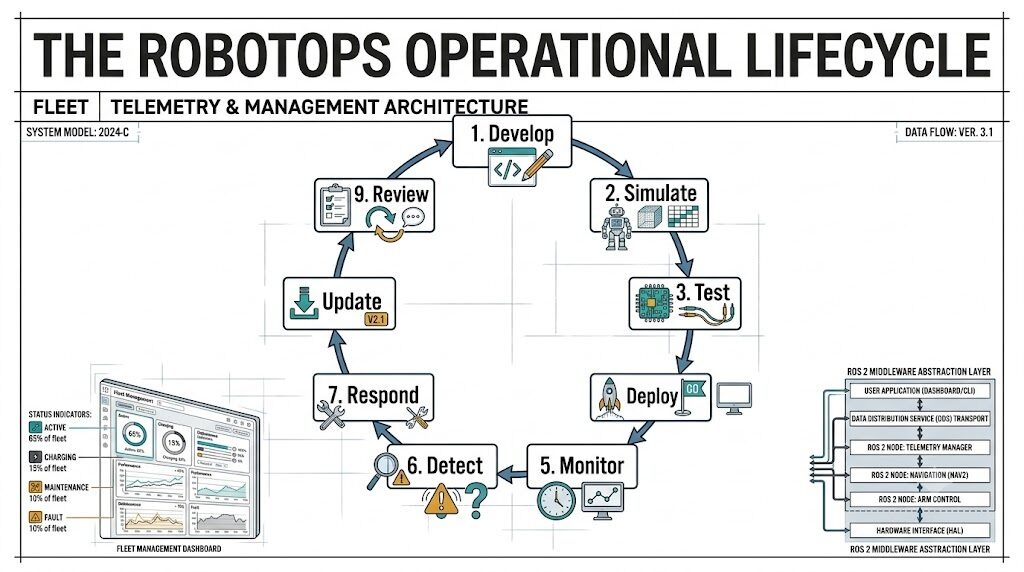
The RobotOps lifecycle connects development work with long-term robot operations in a continuous loop:
Develop → Simulate → Test → Deploy → Monitor → Detect → Respond → Update → Review
Develop: Engineers write modular code, configure communication nodes, and build software packages.
Simulate: The code runs in physics-based virtual worlds to catch path-planning bugs and logic errors early.
Test: Automated integration tests run on hardware test benches and staging units.
Deploy: Software and configuration changes roll out to target machines in small, staged batches.
Monitor: Dashboards collect telemetry, system metrics, and operational performance numbers.
Detect: Automated rules spot abnormal metrics, sensor dropouts, or navigation timeouts.
Respond: Operators isolate affected units, apply remote diagnostic fixes, or dispatch technicians.
Update: Developers fix root causes, test patches, and deploy verified updates to the fleet.
Review: Teams review incident trends to improve software designs, mechanical hardware, and operating procedures.
Security and Safety
In standard software operations, a security breach puts data privacy and service availability at risk. In robotics, security directly affects physical safety. An unauthorized command sent to a robot's drive system can cause mechanical collisions, equipment damage, or personal injury.
Core security practices include:
Authentication and access control: Restricting manual teleoperation and parameter changes to verified personnel.
Device identity: Using unique hardware-backed digital certificates so unauthorized devices cannot join the fleet network.
Secure communication: Encrypting all telemetry, API calls, and middleware messages over local and wide-area networks.
Software integrity: Cryptographically signing software packages and configuration files before installation.
Network security: Isolating robot operational traffic on dedicated, segmented networks.
Audit logs: Maintaining tamper-proof records of who deployed software, updated settings, or issued manual drive commands.
Controlled updates: Enforcing strict change-management reviews before deploying software to physical units.
Remote-access controls: Using secure VPN tunnels or dedicated agents rather than opening raw ports to the internet.
Robotics operations must consider both cybersecurity and physical safety together. Certified hardware emergency-stop circuits and hardware-level safety laser scanners must be able to cut motor power mechanically if an obstacle gets too close, even if the onboard operating system freezes.
Common RobotOps Tools and Technologies
Teams select operational tools based on their robot architecture, fleet size, and work environment:
Robotics middleware: Frameworks like ROS 2 provide the communication backbone for nodes, topics, and services.
Simulation platforms: Virtual simulators like Gazebo allow testing of kinematics, physics, and sensor pipelines.
Monitoring systems: Time-series databases and visualization dashboards like Grafana track fleet metrics.
Logging systems: Centralized log aggregators ingest and index runtime logs for fast search and triage.
Telemetry systems: Lightweight protocols like MQTT or DDS stream real-time operational data from machines.
CI/CD tools: Automation servers like GitHub Actions, GitLab CI, or Jenkins run automated build and test pipelines.
Container platforms: Docker and lightweight runtimes isolate software dependencies on edge hardware.
Fleet management systems: Centralized platforms dispatch tasks, manage traffic, and schedule battery charging.
Cloud infrastructure: Centralized servers manage data storage, fleet orchestration, and historical analysis.
Edge infrastructure: Local facility servers run low-latency fleet services and edge computing workloads.
Configuration management: Tools sync parameter files, site maps, and calibration offsets across units.
Tool selection depends on the project. A small team running five indoor mobile carts does not need a complex distributed cloud stack. Simple, dependable tools are often the most reliable choice.
How to Start Learning RobotOps
Building operational robotics skills requires a practical, step-by-step roadmap:
Learn basic robotics concepts: Understand basic kinematics, differential drives, sensors, actuators, and robot architecture.
Understand Linux and networking: Master terminal navigation, systemd service management, bash scripting, permissions, and IP networking.
Learn software development basics: Practice writing modular code in Python or C++ and using Git for version control.
Learn ROS 2 fundamentals: Study nodes, topics, services, actions, messages, and launch files.
Practice robot simulation: Use simulation tools to model robots, construct virtual environments, and test navigation stacks.
Learn monitoring and observability: Set up basic dashboards to monitor CPU usage, memory, and telemetry data from simulated robots.
Understand CI/CD and automation: Build automated pipelines that compile code, run tests, and package software containers automatically.
Study fleet management: Understand how tasks are dispatched, how map files are shared, and how robot states are tracked across fleets.
Learn robotics security and safety: Study encrypted communication, role-based access control, and hardware-level safety systems.
Build a small RobotOps project: Create a complete project where a simulated mobile robot navigates an environment, reports telemetry to a local dashboard, and receives automated updates.
Common RobotOps Challenges
Operating robots in production presents continuous engineering challenges:
Mixed hardware: Fleets often contain different robot models with unique sensors and compute boards. Teams use containerization and modular software to keep base platforms consistent.
Different software versions: Manual field fixes cause machines to run mismatched configurations. Immutable container deployments ensure every robot runs verified code.
Network failures: Mobile units frequently drop off wireless networks. Software must be built to cache telemetry locally and continue active tasks safely while disconnected.
Limited telemetry: High-frequency sensor streams consume heavy bandwidth. Stream lightweight health summaries continuously, and upload full diagnostic logs only during investigations.
Difficult physical debugging: Replicating real-world failures in a lab is challenging. Recording sensor logs during field incidents allows engineers to replay problems inside simulators.
Fleet-wide updates: A bad update can halt an entire facility. Always release software changes in small, staged batches with automated rollback options.
Safety requirements: Unsecured controls create physical hazards. Combine encrypted software controls with certified hardware emergency-stop circuits.
Scaling monitoring: Ingesting data from hundreds of robots can overload monitoring servers. Downsample telemetry at the edge to send only necessary signals.
Simulation-to-real differences: Code that runs cleanly in simulation can struggle on real surfaces. Always validate updates on physical test units before full deployment.
Coordination between robotics and software teams: Mechanical, electrical, and software engineers must work together closely to diagnose root causes across physical and digital boundaries.
Technical Learning Resources
Operating robots in production requires continuous learning across software engineering, systems administration, and robotics hardware. Practitioners who want to explore detailed guides, tutorials, and technical material covering fleet operations, simulation, and modern robotics software practices can use
Frequently Asked Questions
What is RobotOps?
RobotOps is the operational practice of deploying, monitoring, updating, and maintaining robotic systems throughout their working lifecycle. It connects robotics engineering, software development, and operations to run physical robots reliably in production.
How is RobotOps different from DevOps?
DevOps manages virtual applications and cloud servers. RobotOps manages physical machines that move through real environments, use batteries, and rely on physical sensors and motors. Software failures in robotics directly affect physical operations and human safety.
What is Robot Fleet Management?
Robot Fleet Management includes tracking robot locations, battery states, hardware health, network status, software versions, and active job assignments across multiple units. It also coordinates traffic to prevent deadlocks in shared spaces.
Why is simulation important in RobotOps?
Simulation allows engineers to test software changes, path planning, and edge cases inside a safe virtual world. This helps teams catch software errors early without risking damage to physical hardware or causing facility downtime.
How does ROS 2 fit into RobotOps?
ROS 2 provides a modular middleware framework that allows different robot programs to communicate reliably. RobotOps manages the deployment, configuration, logging, and health monitoring of those ROS 2 nodes in production.
What does a Robotics Operations Center do?
A Robotics Operations Center provides a centralized operational view of fleet telemetry, error logs, deployment states, and alerts. It helps operations teams detect, diagnose, and resolve fleet issues quickly from a single interface.
What should beginners learn before studying RobotOps?
Beginners should build a foundation in Linux command-line tools, basic IP networking, Python or C++ programming, and core robotics concepts such as sensors, actuators, and coordinate frames.
Conclusion
Developing functional robot software is an important engineering achievement, but operating robots in production requires an ongoing operational commitment. Reliable field robotics connects software engineering, simulation, testing, staged deployments, active monitoring, fleet coordination, and routine maintenance. RobotOps brings these activities together around physical systems in the real world. By investing in clear observability, automated maintenance pipelines, and disciplined lifecycle management, organizations can keep their robotic fleets working safely, reliably, and productively at scale.