A Parent's Practical Guide to Choosing Tutors, Coaching Centers, and Colleges in India
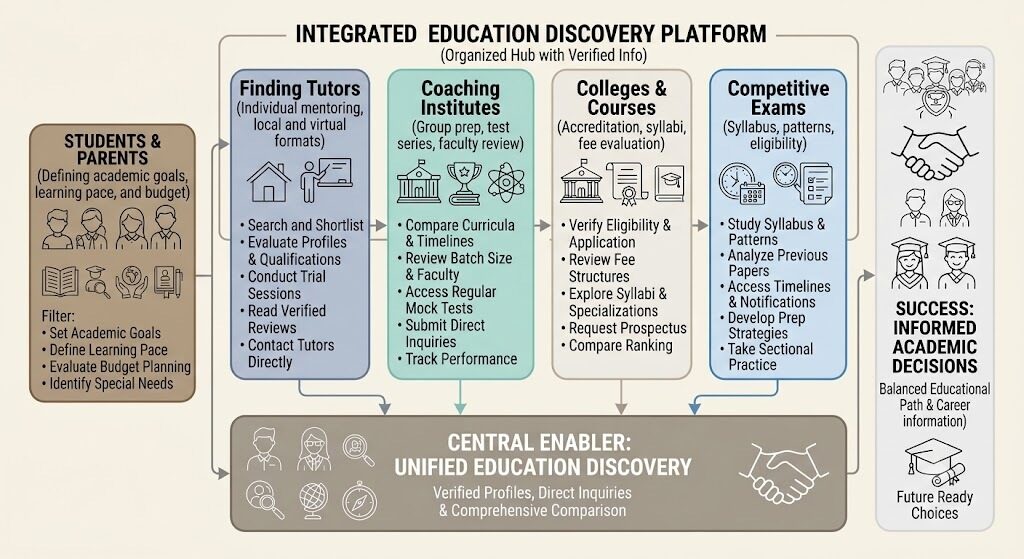
Every academic milestone brings a fresh set of choices for students and parents. A middle-school learner might need individual help with mathematics, while a high-school student balances board preparations with national entrance tests. Later, school leavers face the demanding task of selecting degree programs and universities that match their interests and long-term career goals.
Making these choices often feels overwhelming because the necessary information is scattered across hundreds of disconnected websites, promotional flyers, social media ads, and informal peer recommendations. Without an organized way to verify claims and review practical details, families risk committing significant time, effort, and money to options that do not suit the learner's actual requirements. A dependable decision comes from comparing verified facts—such as syllabus coverage, teacher experience, batch sizes, and institutional accreditation—before making a commitment. This is where education discovery resources like GurukulGalaxy offer value by bringing tutors, training centres, colleges, and structured exam details into a single research space.
Finding the Right Tutor
Private tutoring provides personalized guidance that standard classrooms cannot always deliver. A dedicated mentor can clarify difficult concepts, reinforce disciplined study routines, and adapt pacing to a student's natural learning speed. However, because teaching styles vary widely, finding a suitable match requires more than picking the first contact on a local notice board.
When families decide to
Subject Mastery and Curriculum Familiarity: Confirm that the educator has substantial experience with the student’s specific board or curriculum (such as CBSE, ICSE, state boards, or international boards). A tutor familiar with the marking schemes and syllabus patterns can provide targeted guidance.
Teaching Methodology: Every student processes information differently. Some need visual explanations and practical examples, while others benefit from structured problem sets. An introductory conversation or trial class helps identify whether the tutor’s style matches the student’s learning needs.
Format and Availability: Determine whether virtual sessions or in-person home visits work better. Virtual lessons offer scheduling flexibility and save travel time, making it practical to consult experienced online tutors India regardless of where the family resides.
Logistics and Pacing: Establish clear expectations regarding lesson duration, frequency, monthly fees, and cancellation policies before starting regular sessions.
For families who prefer face-to-face supervision, searching locally to find tutors near me remains an effective way to connect with reliable educators in nearby areas, ensuring easy coordination and direct oversight.
Researching Coaching Institutes
Coaching centres serve a different academic purpose than individual tutors. They provide competitive peer environments, rigorous test schedules, and standardized study modules designed for large-scale assessments. Because enrolling in an institute represents a major financial and time commitment, decisions should never rely on marketing billboards or unverified topper lists.
When assessing coaching centres, look past the promotional banners and examine operational details:
Faculty Consistency: Ask who will actually teach the primary batches. Reputable institutes sometimes advertise senior faculty during enrollment seminars, while routine classroom sessions are assigned to junior instructors.
Batch Size and Student Support: Enormous batch sizes make it hard for introverted learners to ask questions. Inquire about formal doubt-clearing sessions, mentor availability outside class hours, and faculty-to-student ratios.
Relevance of Study Material: Review sample booklets or test modules. Quality study material emphasizes conceptual clarity, step-by-step solutions, and graded difficulty levels over mere physical volume.
Commute and Daily Schedules: Long daily commutes drain the physical energy needed for independent study. When looking for coaching institutes near me, balance the reputation of the center with the daily travel time required.
Students researching the best coaching institutes in India should treat this phrase as a comparative search inquiry rather than an absolute standard. The most suitable institute is not the one with the biggest advertising budget, but the one whose teaching pace, class size, and support system match the student's current baseline.
Searching for Colleges and Courses
Entering higher education is a formative decision that influences intellectual growth, professional opportunities, and personal independence. Rather than applying based on general brand recognition, students should examine the concrete elements of individual degree programs.
Before finalizing applications, systematic research into several core areas is necessary:
Curriculum and Specializations: Look at the semester-by-semester syllabus on the institution's official portal. Check if the course includes practical laboratory work, modern software tools, electives, and mandatory internships.
Eligibility and Admission Guidelines: Review the minimum qualifying percentages, required school subjects, entrance test score cut-offs, and reservation norms to ensure your profile meets the requirements.
Accreditation and Statutory Approvals: Verify that the institution holds proper recognition from statutory higher education bodies and recognized accreditation councils. A valid degree is essential for higher studies, government employment, and international equivalency.
Total Cost of Attendance: Calculate the full expense over the entire program duration, factoring in tuition fees, semester exam charges, laboratory fees, hostel accommodation, meals, and daily living costs.
Using platforms for college search India allows learners to evaluate institutions across different states objectively. Taking the time to compare colleges and courses side by side ensures that students evaluate academic structure, campus infrastructure, and fee schedules together, leading to balanced higher education choices.
Understanding Competitive Exams
Competitive tests operate under fundamentally different rules than school or university examinations. Standard academic assessments test whether a student has reached an absolute standard of understanding to award a grade. Competitive assessments, by contrast, serve as relative ranking mechanisms where thousands—and sometimes millions—of candidates compete for a limited number of seats.
Before committing months or years to a specific test pathway, students need to understand what the examination entails:
Eligibility Norms and Attempt Limits: Check official notifications for age thresholds, minimum academic percentages, subject prerequisites, and the maximum allowed attempts.
Syllabus and Weightage: Download the official syllabus breakdown. Identifying high-weightage topics and core foundational concepts helps prioritize study hours effectively.
Exam Format and Marking Schemes: Understand the operational format (computer-based or pen-and-paper), question types (multiple-choice questions, numerical values, or descriptive essays), and negative marking rules.
Study Planning and Mock Practice: Successful competitive exam preparation requires consistent time management and structured revision cycles rather than sporadic bursts of study. Taking regular mock tests under timed conditions and analyzing incorrect answers provides actionable insight into operational weak points.
This planning is particularly vital for school leavers reviewing competitive exams after 12th. Whether aiming for engineering, medicine, law, commerce, management, design, or central university entrance tests, knowing the exam structure and registration deadlines well in advance prevents last-minute confusion. Familiarizing oneself with the full scope of competitive exams in India helps students choose pathways aligned with their genuine strengths rather than following peer momentum.
How GurukulGalaxy Can Help
Sorting through fragmented information from dozens of university portals, coaching leaflets, independent tutor listings, and exam notices consumes valuable time. GurukulGalaxy addresses this challenge by providing an organized education discovery platform that brings these educational components into one accessible location.
The platform provides a structured environment where students, parents, and working learners can explore options without navigating confusing advertising networks:
Tutor Discovery: Browse educator profiles by subject expertise, teaching format, location, and learner requirements to find suitable mentors for individual academic needs.
Institution Directories: Search for nearby coaching centres and specialized training institutes, reviewing program offerings and basic details.
College and Course Research: Explore higher education institutions, review program curriculums, and evaluate eligibility parameters across multiple disciplines.
Exam Information: Access structured summaries covering exam patterns, eligibility guidelines, critical dates, and preparation syllabi for various national and state assessments.
Direct Enquiries: Send inquiries directly to educational providers to clarify batch timings, course fees, and admission criteria before taking the next step.
By gathering verified educational data, GurukulGalaxy enables learners to approach their academic journey systematically, replacing guesswork with organized research.
Practical Education Research Checklist
Before finalizing any significant educational commitment, work through this practical checklist:
Clarify the Goal: Define whether you need remedial assistance in a single subject, comprehensive entrance exam coaching, or a four-year professional degree.
Verify Official Recognition: For tutors, review educational credentials; for coaching centres, check faculty stability; for colleges, confirm statutory regulatory approvals.
Review Sample Materials: Request an introductory session with a tutor, inspect sample study booklets from a coaching institute, or examine the updated syllabus of a college program.
Calculate Full Costs: Include hidden expenses such as study materials, examination fees, transportation, hostel charges, and living expenses alongside base tuition fees.
Evaluate Daily Travel Time: Ensure that the daily commute leaves realistic hours for rest, physical activity, and unassisted self-study.
Rely on Verified Facts: Base decisions on documented curriculum details, verified faculty profiles, and transparent fee policies rather than promotional guarantees.
How can students find a suitable tutor online?
Start by identifying the exact subjects and topics where help is needed, as well as your available weekly budget. Review tutor profiles for relevant academic qualifications and curriculum experience. Always schedule an introductory session or trial class to evaluate whether the tutor's pacing and explanation methods work well for the learner.
What should students check before joining a coaching institute?
Look beyond brand popularity and marketing claims. Verify who will teach the actual classes for your batch, ask about the average class size, check the schedule for personal doubt-clearing sessions, and calculate the daily travel time to ensure the routine is sustainable.
How can students compare colleges and courses?
Compare the detailed semester syllabi on official institutional websites rather than relying on promotional brochures. Review regulatory recognitions, laboratory and library facilities, eligibility rules, and the total cost of attendance, including living and hostel expenses.
What should students know before choosing a competitive exam?
Read the official notification thoroughly to understand eligibility conditions, subject prerequisites, the marking scheme (including negative marks), test duration, and historic cut-off trends. This helps assess whether the exam format matches your academic strengths.
How can an education discovery platform help students?
An education discovery platform consolidates verified profiles of tutors, coaching centres, colleges, and entrance exams in one searchable location. This allows students and parents to evaluate and compare options side by side, saving time and reducing reliance on biased promotional claims.
Conclusion
Academic progress is built on a series of thoughtful, practical choices. Selecting a personal tutor, enrolling in a specialized coaching institute, choosing a college course, or committing to an entrance examination each play a distinct role in shaping an educational journey. When families rely on unverified advice or rushed decisions, the resulting mismatches can create unnecessary stress.
Taking the time to research thoroughly, compare practical details, and evaluate options against personal goals leads to far better academic outcomes. Platforms like GurukulGalaxy support this process by bringing tutors, training centres, colleges, and exam resources into one transparent discovery ecosystem. Approaching education with clear questions, verified facts, and steady research helps students choose learning pathways that foster genuine growth and long-term confidence.