The Comprehensive Guide to Researching Assisted Reproduction and Clinic Transparency
Navigating fertility care often begins with an overwhelming amount of online information. Between varying medical explanations, complex price lists, and differing clinic claims, finding clear and objective guidance can feel challenging. Because fertility care is highly individualized, what applies to one person or couple may not apply to another.
Learning how to evaluate medical options, understand pricing structures, interpret statistics responsibly, and verify provider credentials allows individuals to make informed decisions. A structured approach turns an overwhelming process into a manageable, step-by-step exploration of available care.
Understanding Fertility Treatment Options
Before selecting a clinic or treatment path, it helps to understand the foundational fertility treatment options available today. Fertility care spans a spectrum from non-invasive diagnostic monitoring to advanced assisted reproductive technology (ART).
Common options include:
Fertility Testing and Diagnostics: Baseline assessments of ovarian reserve, semen parameters, fallopian tube patency, and hormone profiles help identify underlying factors affecting conception.
Medication-Based Management: Ovulation induction using oral or injectable medications can assist individuals experiencing irregular ovulation, including those with polycystic ovary syndrome (PCOS).
Intrauterine Insemination (IUI): A procedure where prepared sperm is placed directly inside the uterus around the time of ovulation.
In Vitro Fertilization (IVF): An assisted reproductive process where eggs are retrieved from the ovaries, fertilized in an embryology laboratory, and transferred to the uterus as embryos.
Intracytoplasmic Sperm Injection (ICSI): A specialized laboratory technique often used alongside IVF to assist fertilization.
Fertility Preservation (Egg, Sperm, or Embryo Freezing): Cryopreservation allows individuals to store genetic material for future family planning or before medical treatments that might impact fertility.
Because each person's diagnostic profile is unique, establishing baseline medical facts with a physician is always the first step.
Understanding IVF and ICSI
Patients exploring assisted reproduction often encounter discussions regarding ICSI vs IVF. While both approaches share similar preparation, stimulation, and retrieval protocols, they diverge in the embryology laboratory during the fertilization step.
In standard conventional IVF, retrieved eggs are placed in a specialized culture dish alongside tens of thousands of motile sperm, allowing fertilization to occur naturally. In contrast, ICSI involves an embryologist selecting a single mature sperm and injecting it directly into an egg.
Medical teams typically consider ICSI in cases involving male-factor infertility (such as low sperm count, poor motility, or atypical morphology), prior unexplained fertilization challenges, or when using frozen eggs. Neither procedure is universally "better"; the choice depends on diagnostic results, clinical indications, and the guidance of an embryology team.
How to Compare Fertility Providers
Finding the right care team involves more than selecting the most visible practice online. To responsibly compare IVF clinics, patients should look across multiple operational, clinical, and financial criteria:
Treatments Offered: Does the center support specific pathways, such as third-party reproduction, genetic testing, or mild stimulation protocols?
Professional Qualifications: Review the board certifications, training, and subspecialties of the reproductive endocrinologists, embryologists, and nursing staff.
Laboratory Quality: An embryology laboratory's air filtration, equipment standards, and accreditation play a central role in embryo development and storage security.
Diagnostic Capabilities: On-site ultrasound, blood laboratories, and hysteroscopy services streamline monitoring appointments.
Pricing Transparency: Clear breakdowns detailing baseline costs, package inclusions, and potential add-on fees.
Location and Continuity of Care: Frequent monitoring appointments require practical access to the clinic or affiliated local monitoring centers.
Applicable Regulations: Ensure the clinic complies with local, regional, or national health authority oversight.
Independent research platforms like IVFHospitalsNow.com provide educational overviews that help patients organize these details, allowing prospective patients to review service profiles and understand provider structures before scheduling consultations.
Finding Local Providers
Conducting online searches for IVF clinics near me is often the primary way people locate providers within driving distance. Geographic proximity is genuinely practical: an active treatment cycle requires frequent early-morning blood draws and ultrasound scans over two to three weeks.
However, convenience should not be the sole deciding factor. A nearby clinic must also align with your specific diagnostic needs, communication preferences, and financial expectations. If a local clinic lacks experience with your specific reproductive diagnosis, exploring regional centers or clinics offering remote monitoring partnerships may be worthwhile.
Understanding IVF Treatment Cost
The total IVF treatment cost is rarely captured in a single flat number. Instead, treatment involves multiple phases, each with its own associated expenses:
Initial Consultations and Pre-Cycle Testing: Ovarian reserve testing, infectious disease screening, genetic carrier screening, and semen analysis.
Ovarian Stimulation Medications: Fertility medications to stimulate the ovaries are typically purchased through specialty pharmacies and billed separately from clinic fees.
Cycle Monitoring: Regular blood tests and transvaginal ultrasounds to track follicle growth and adjust medication dosages.
Procedures: Surgical egg retrieval, anesthesia fees, and the subsequent embryo transfer.
Laboratory Services: Fertilization, embryo culture, blastocyst development, and optional procedures such as preimplantation genetic testing (PGT).
Cryopreservation and Storage: Freezing extra embryos and paying ongoing annual storage maintenance fees.
When reviewing financial materials, ask the provider for an itemized list of what is included in the base cycle quote and which services incur extra charges.
Considering IVF Treatment Abroad
Some individuals explore IVF treatment abroad due to cost considerations, access to specific donor programs, or legal limitations in their home countries. While cross-border reproductive care can offer viable pathways, it introduces distinct logistical and legal factors:
Travel and Timing: Flexibility is essential. Ovarian response can vary, meaning trip lengths, flight changes, and accommodation stays may need adjustment on short notice.
Medical Record Transfer: Ensuring diagnostic records, lab results, and medical histories are translated accurately and received ahead of travel.
Communication: Understanding how clinical updates are delivered, whether translators are available, and who coordinates care across time zones.
Local Regulations: Legal frameworks governing embryo genetic testing, donor anonymity, parental rights, and embryo storage vary significantly across borders.
Post-Treatment Follow-Up: Planning for early pregnancy monitoring, blood tests, and continuing prescribed medications after returning home.
Receiving care overseas requires coordination between an international clinic and a supportive local physician willing to oversee baseline or return monitoring.
Comparing IVF Cost by Country
When researching medical travel, evaluating IVF cost by country requires looking beyond headline figures. A published package price that appears significantly lower at first glance may exclude essential components.
To make an accurate comparison, factor in:
Package Scope: Does the quote include medications, ICSI, blastocyst culturing, embryo freezing, and the initial transfer, or are these billed separately?
Ancillary Medical Fees: Pre-travel testing, anesthesia, medication adjustments, and post-transfer medications.
Non-Medical Travel Costs: Flights, local transit, lodging for two to three weeks, meals, and emergency contingency funds.
Currency and Payment Rules: Exchange rates, international wire fees, and local health system taxes.
A complete financial comparison considers all door-to-door expenses rather than comparing an all-inclusive domestic package to a procedure-only foreign quote.
Understanding IVF Success Rates
Interpreting IVF success rates requires a careful look at how clinical data is calculated and presented. A high percentage published on a website does not represent an individual guarantee of success.
When reviewing published data, keep the following context in mind:
Patient Age: Age remains one of the most critical variables affecting egg quality and cycle outcomes. Data should be reviewed within your specific age bracket.
Patient Characteristics: Some clinics treat higher proportions of complex or previously unsuccessful cases, which naturally impacts overall clinic averages.
Metric Definitions: Clarify whether the published figure refers to positive pregnancy tests (biochemical pregnancy), ultrasound-confirmed heartbeats (clinical pregnancy), or live births per cycle.
Cycle-Based vs. Cumulative Rates: Live birth rates per embryo transfer differ from cumulative rates achieved over multiple retrieval cycles.
Data Sources and Transparency: Reliable clinics report data to established national or regional registries that use standardized reporting methodologies.
A single statistic cannot predict an individual outcome. Success probabilities should always be evaluated alongside a reproductive specialist based on your unique clinical history.
Understanding Egg Freezing Cost
Evaluating the egg freezing cost requires looking at both the upfront procedural expenses and the long-term maintenance fees. Elective oocyte cryopreservation involves many of the same early phases as an IVF cycle, minus fertilization and embryo transfer.
Primary expense categories include:
Diagnostic ovarian reserve testing (AMH and antral follicle counts).
Stimulation and trigger medications.
Clinical monitoring throughout the stimulation phase.
Surgical egg retrieval and anesthesia.
Laboratory vitrification (flash-freezing) of mature eggs.
Initial storage fees (often included for the first 6 to 12 months).
Ongoing annual storage fees to maintain cryopreserved eggs.
Future expenses: Thawing, fertilization via ICSI, embryo culture, and embryo transfer when ready to use the eggs.
Educational platforms such as IVFHospitalsNow.com help readers break down these phased financial components so they can estimate total short- and long-term costs accurately.
Evaluating Online Fertility Information
Because health-related content varies widely in accuracy, evaluating online fertility resources requires a discerning eye:
Source Credibility: Check whether the platform is transparent about its mission, authors, and funding sources.
Medical Oversight: Trustworthy health resources clearly indicate if content has been written or reviewed by qualified reproductive professionals.
Publication and Update Dates: Reproductive medicine evolves rapidly; ensure the guidance reflects current standards of care.
Citations and Evidence: Reliable educational material references clinical studies, recognized reproductive societies, or regulatory bodies.
Nature of the Content: Distinguish between general educational overviews and personalized medical advice. General information should inform your doctor visits, not replace them.
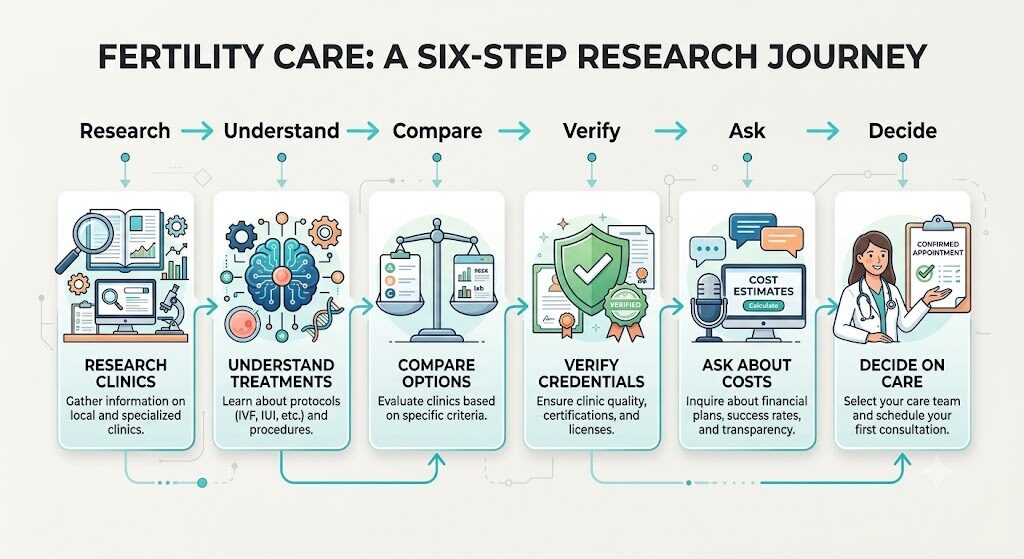
Simple Fertility Research Workflow
To keep your research organized, consider using this structured six-step workflow:
Research: Read objective medical explanations regarding reproductive health, testing protocols, and basic procedures.
Understand: Identify what specific diagnostic tests indicate and how different pathways align with your personal circumstances.
Compare: Look at several accredited IVF clinics, weighing laboratory credentials, service transparently, pricing, and communication practices.
Verify: Confirm provider licensing, clinic accreditations, and regulatory reporting through regional health boards or professional associations.
Ask: Bring a prepared list of specific questions regarding protocols, costs, and timeline expectations to consultations.
Decide: Choose a treatment plan and provider collaboratively with your medical specialist, supported by clear facts.
Practical Provider Checklist
When contacting or meeting with fertility care teams, use this checklist to guide your conversations:
[ ] What diagnostic workups are required before starting a cycle, and can these be completed locally?
[ ] Which specific reproductive treatments and laboratory techniques (such as ICSI or PGT) are handled routinely on-site?
[ ] What are the board certifications and primary qualifications of the attending physicians and laboratory directors?
[ ] Can the clinic provide a written, itemized breakdown of base cycle costs, medications, and potential add-on fees?
[ ] What are the potential additional charges if a cycle requires extended culture or emergency procedures?
[ ] How does the clinic track, submit, and publish its clinical outcome metrics?
[ ] Where will routine morning monitoring appointments take place?
[ ] What regulatory bodies inspect and license the clinic and its embryology lab?
[ ] How does the team handle weekend procedures, after-hours emergencies, and post-cycle follow-up?
Frequently Asked Questions
How should I compare IVF clinics?
To compare IVF clinics effectively, evaluate their diagnostic capabilities, physician qualifications, laboratory standards, communication practices, and pricing transparency. Rather than relying on marketing claims alone, compare itemized service lists and ask detailed questions during initial consultations.
What factors affect IVF treatment cost?
An IVF treatment cost is influenced by required medication dosages, diagnostic testing, laboratory techniques such as ICSI or genetic testing, anesthesia fees, and the number of cycles or embryo transfers needed. Storage fees for cryopreserved genetic material also contribute to the final expense.
How should I interpret IVF success rates?
Examine IVF success rates by looking specifically at your age group, your individual diagnosis, and whether the data measures clinical pregnancies or actual live births. A single percentage should be treated as general historical context rather than a personal guarantee.
What should I consider before choosing IVF treatment abroad?
Before committing to IVF treatment abroad, evaluate travel logistics, language barriers, legal regulations surrounding reproductive care in the destination country, and how you will coordinate monitoring and post-transfer care with a doctor in your home country.
How can IVF cost by country be compared fairly?
Fairly evaluating IVF cost by country requires tallying all associated expenses, including pre-cycle diagnostics, medications, flights, accommodations, translation services, currency conversion rates, and post-treatment care, rather than comparing base clinic quotes alone.
What is the difference between ICSI vs IVF?
In conventional IVF, an egg is placed in a dish with thousands of sperm to fertilize naturally. In ICSI, an embryologist injects a single sperm directly into a mature egg. ICSI is typically selected to address severe male-factor infertility or previous low fertilization rates.
What factors affect egg freezing cost?
An egg freezing cost includes pre-cycle diagnostic testing, ovarian stimulation medications, cycle monitoring, surgical retrieval, laboratory vitrification, and ongoing annual storage fees. Future expenses related to thawing, fertilizing, and transferring embryos should also be considered.
Conclusion
Researching fertility care is a journey that benefits from patience, thoroughness, and reliable information. By taking the time to understand the differences between procedures, demanding transparency around treatment costs, interpreting clinical statistics with proper context, and consulting qualified reproductive professionals, individuals can navigate their choices with confidence. Educational discovery platforms such as IVFHospitalsNow.com can serve as helpful starting points for exploring provider profiles and general treatment frameworks, laying the groundwork for productive conversations with your personal healthcare team.