Building Sustainable Delivery Capabilities for Enterprise Engineering Teams
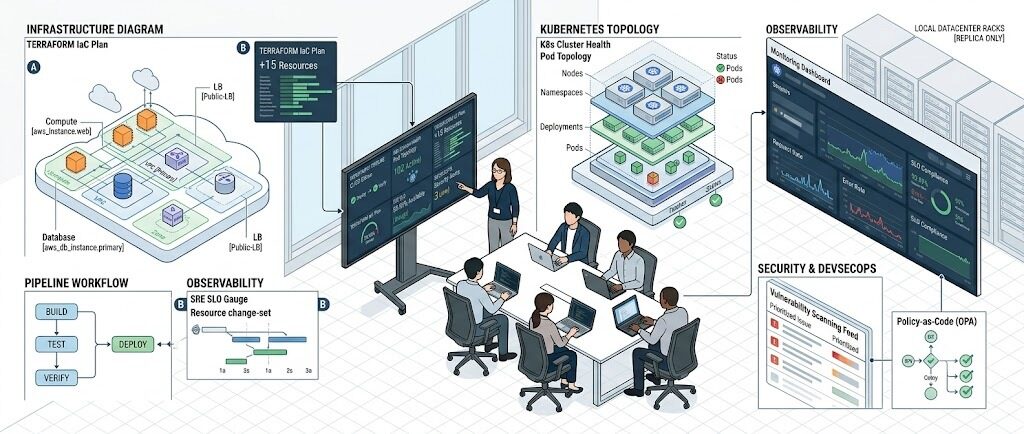
Many technology organizations encounter friction not from a lack of technical tools, but from the challenge of turning individual tools into cohesive engineering capabilities. Modern software delivery requires aligning automated workflows, cloud environments, operational reliability, continuous security, and human skills into a unified operational approach. When tools are adopted in isolation without addressing team processes, the result is often fragmented architecture, persistent manual interventions, and operational bottlenecks.
Building genuine capability requires looking beyond individual utilities to examine how systems are constructed, deployed, monitored, and maintained throughout their lifecycle. A sustainable delivery model balances release velocity with system stability and governance. For engineering groups navigating this operational transition, participating in a structured DevOps 研修 helps bridge the divide between theoretical automation principles and day-to-day production delivery workflows.
Evaluating Current Engineering Workflows
Before introducing additional platforms or refactoring pipelines, teams benefit from conducting an objective assessment of their existing software delivery lifecycle. Rushing into technical migrations without identifying systemic friction points often shifts complexity from one layer of the technology stack to another.
Engineering leaders should consider several practical operational areas:
Deployment workflows: Are releases automated, predictable, and frequent, or do they rely on manual scripts, extensive coordination meetings, and scheduled downtime?
Infrastructure provisioning: Is cloud infrastructure created and updated consistently through defined code, or through manual adjustments in cloud management consoles?
System observability: Can engineering teams trace distributed transactions and detect performance anomalies before end-users experience degradation?
Operational ownership: Are incident management, telemetry reviews, and system maintenance shared responsibilities, or isolated within specific operational units?
Security integration: Are security verifications conducted early within development branches, or treated as a final administrative checkpoint prior to production release?
Internal capabilities: Do internal developers and platform operators possess the practical competencies needed to design, maintain, and troubleshoot modern distributed systems?
Evaluating these operational factors allows organizations to target capability gaps directly. Engaging in comprehensive DevOps コンサルティング provides technical leadership with an external, objective evaluation of current delivery pipelines, helping establish realistic capability roadmaps tailored to specific organizational structures and governance requirements.
Establishing a Resilient Cloud-Native Foundation
Cloud-native patterns have become the foundation of modern application deployment. By packaging applications into self-contained container images, development teams achieve runtime consistency across local development workstations, testing clusters, and production cloud environments.
However, operating microservices at enterprise scale requires robust container orchestration to manage scheduling, networking, storage mounting, service discovery, and rolling software updates. When teams treat container orchestrators merely as generic virtual machine hosts, they fail to leverage declarative deployment automation and self-healing systems. Enrolling in focused Kubernetes 研修 allows platform engineers and application developers to master cluster configuration, ingress management, pod lifecycle policies, and resource quotas, ensuring that container platforms operate as dependable delivery engines rather than isolated administrative silos.
Adopting Repeatable Infrastructure as Code
Manual server provisioning and console-based configuration changes inevitably lead to environment drift, untracked modifications, and prolonged incident recovery times. Infrastructure as Code (IaC) applies software engineering rigor to platform architecture by defining compute, networking, and storage resources in version-controlled configuration files.
Declarative infrastructure allows engineering teams to review proposed environment modifications through standard pull requests, test changes against automated policies, and provision environments reproducibly. Through targeted Terraform 研修, engineers gain practical experience in writing reusable infrastructure modules, managing shared remote state files securely, planning execution graphs, and systematically preventing discrepancies between codified configurations and running production assets.
Embedding Reliability into Everyday Engineering
Service availability cannot be treated as an afterthought addressed only when production outages occur. In complex distributed topologies, transient network failures, memory pressures, and infrastructure outages are inevitable. Site Reliability Engineering (SRE) establishes engineering practices that maintain platform stability while supporting continuous feature delivery.
Key operational principles include:
Service Level Indicators (SLIs) and Service Level Objectives (SLOs): Quantifying availability and latency targets based on user-impacting thresholds rather than arbitrary infrastructure metrics.
Error budgets: Establishing objective data points that guide when to accelerate feature releases or dedicate sprint cycles to platform stability and technical debt reduction.
Alert management: Configuring low-noise, actionable alerts that notify engineers only when user-facing service availability is genuinely threatened.
Blameless post-mortems: Analyzing production incidents to identify systemic and architectural weaknesses rather than assigning personal fault, turning operational failures into architectural improvements.
Participating in structured SRE 研修 provides development and operations teams with practical methodologies to design observable architectures, automate incident response workflows, and establish continuous operational feedback loops across the software lifecycle.
Integrating Security Across Software Delivery
Traditional enterprise security models that rely on manual reviews immediately before production deployment create operational friction and extend delivery timelines. Modern DevSecOps practices embed automated compliance checks, scanning routines, and vulnerability assessments directly into the continuous integration and continuous deployment (CI/CD) pipeline.
A comprehensive automated security model includes:
Static Application Security Testing (SAST): Scanning application source code for known security vulnerabilities and insecure coding patterns during development.
Software Composition Analysis (SCA): Continuously monitoring open-source dependencies and third-party libraries for newly disclosed vulnerabilities.
Secrets management: Implementing automated scanning tools to prevent access tokens, private keys, and passwords from entering source code repositories.
Policy as code: Codifying infrastructure compliance and container hardening standards to prevent insecure resources from being provisioned to cloud environments.
Undertaking specialized DevSecOps 研修 helps development, platform, and security teams collaborate effectively, ensuring that automated verification tools protect production environments without unnecessarily halting delivery cadences.
Managing Machine Learning Workloads with MLOps
Machine learning models introduce unique operational complexities that standard software delivery pipelines are not equipped to handle alone. In addition to application source code, machine learning systems must track evolving training datasets, hyperparameter configurations, experiment runs, and serialized model artifacts.
Without automated operational pipelines, moving models from research environments into production inference systems often results in unrepeatable manual deployments and silent performance degradation. Through dedicated MLOps 研修, cross-functional teams learn how to implement reproducible data preprocessing pipelines, manage version-controlled model registries, orchestrate continuous validation, and monitor runtime inference data for drift, ensuring algorithmic services remain dependable in production.
Cultivating Engineering Skills Through Applied Practice
Software tooling alone cannot build sustainable engineering capability; organizations must invest deliberately in their technical talent. Providing access to self-paced videos or passive documentation rarely results in production-ready competencies. Sustainable skill development requires structured learning environments coupled directly with hands-on practice.
Effective technical education relies on:
Hands-on lab environments: Allowing engineers to practice building, deploying, and troubleshooting systems within realistic cloud infrastructures.
Internal engineering standards: Aligning training topics with the organization's specific technical patterns, architectural guidelines, and tooling standards.
Mentorship and peer review: Reinforcing new technical practices through collaborative code reviews, architectural pairing, and knowledge-sharing sessions.
Implementation projects: Giving engineers immediate opportunities to apply newly acquired skills to real business applications and infrastructure components.
Investing in comprehensive DevOps corporate training Japan enables enterprise teams to build practical internal proficiencies that translate directly into improved delivery workflows, operational stability, and reduced dependency on external workarounds.
Engaging External Advisory and Technical Support
While building internal ownership is the ultimate objective for any organization, navigating complex cloud-native architectures, regulatory compliance, and distributed deployments often benefits from experienced external guidance. Enterprises frequently encounter challenges when migrating legacy applications, implementing container governance, or standardizing multi-cloud networking.
Engaging an experienced DevOps consultant Japan can help technology leaders evaluate current architectures, avoid common operational pitfalls, and design modern delivery frameworks tailored to local enterprise requirements. Furthermore, securing continuous DevOps support Japan ensures that internal engineering teams have access to ongoing troubleshooting assistance, architectural reviews, and operational guidance as production systems expand.
Implementing Practical Capabilities with DevOpsSchool.jp
Building well-rounded engineering capability requires access to structured education, practical implementation assistance, and reliable technical consulting. DevOpsSchool.jp is a specialized, Japan-focused platform supporting enterprises, IT managers, software developers, and platform engineers looking to improve modern software delivery, infrastructure automation, reliability, and security practices.
The platform provides comprehensive assistance across modern engineering domains:
Structured corporate training programs covering container platforms, infrastructure automation, observability, and continuous delivery.
Advisory consulting designed to help enterprises evaluate deployment workflows, design cloud architectures, and establish modern operating models.
Practical implementation guidance for configuring Kubernetes clusters, automating deployment pipelines, and codifying infrastructure securely.
Dedicated ongoing professional support tailored to the operational requirements of Japanese enterprise environments.
Through specialized educational offerings, including hands-on
Practical Capability-Building Roadmap
Assess
Evaluate existing delivery workflows, deployment cadences, manual handoffs, operational bottlenecks, and internal technical skill gaps across engineering teams.
Prioritize
Identify high-impact, manageable areas for improvement, such as codifying core infrastructure components, automating deployment verifications, or establishing basic observability baselines.
Learn
Equip engineering teams with structured technical knowledge and hands-on lab experience covering container orchestration, infrastructure automation, and modern reliability patterns.
Implement
Apply codified configurations, automated delivery pipelines, and standardized operational practices directly to active development, staging, and production environments.
Observe
Use centralized telemetry, distributed tracing, error tracking, and team retrospectives to monitor system performance, operational toil, and delivery velocity under real-world conditions.
Improve
Continuously refine deployment automation, security validations, reliability metrics, and internal documentation based on empirical production data and team feedback.
Practical Engineering Checklist
Are deployment and release processes automated, predictable, and repeatable across environments?
Is cloud infrastructure declared in version-controlled repositories and updated via peer-reviewed pipelines?
Are distributed systems observable through centralized metrics, structured logs, and distributed traces?
Are availability goals, service level objectives, and incident response procedures clearly documented?
Are vulnerability scanning, dependency checks, and compliance tests embedded into automated CI/CD pipelines?
Are machine learning models, training data pipelines, and validation steps versioned and reproducible?
Do engineering teams have access to hands-on technical learning programs aligned with production standards?
Is there a defined path connecting structured training directly to internal implementation initiatives?
Do platform teams have reliable access to experienced technical guidance and operational support when tackling complex architectural migrations?
Final Takeaways
Focus on outcomes over tooling: Define clear delivery processes, reliability expectations, and security standards before purchasing or deploying software platforms.
Codify environments systematically: Use declarative configuration files and version control to eliminate manual environment setup and prevent configuration drift.
Treat reliability as an ongoing discipline: Implement quantitative service level objectives and blameless retrospectives to balance deployment velocity with system availability.
Embed security early: Automate vulnerability assessments and configuration policy enforcement directly within continuous integration workflows.
Apply operational discipline to machine learning: Standardize data tracking, experiment logging, model validation, and deployment pipelines for production ML workloads.
Connect education to implementation: Ensure technical training is accompanied by hands-on lab exercises and applied directly to production-grade engineering workflows.
Refine systems iteratively: Use runtime telemetry, operational feedback, and blameless reviews to continuously improve architecture, automation, and team processes.
What does practical DevOps capability mean for an enterprise engineering team?
Practical DevOps capability refers to an organization's internal proficiency in building, deploying, monitoring, and securing software predictably and repeatedly. Rather than merely adopting a collection of tools, it emphasizes cohesive workflows, automated guardrails, shared operational ownership, and continuous system improvement.
Why is infrastructure as code preferred over manual cloud configuration?
Managing infrastructure through code allows environments to be version-controlled, auditable, and easily reproduced. It replaces manual console configurations with peer-reviewed pull requests, preventing undocumented configuration drift between staging and production environments while simplifying disaster recovery.
How does Site Reliability Engineering support modern DevOps adoption?
SRE provides concrete, data-driven frameworks—such as Service Level Indicators (SLIs), Service Level Objectives (SLOs), and error budgets—that balance the demand for rapid feature releases with the requirement for system availability. It helps teams proactively monitor service performance and prioritize platform stability work.
Why is it necessary to integrate security checks directly into the delivery pipeline?
Automating security assessments during early development stages allows teams to identify vulnerabilities, outdated dependencies, and misconfigurations when they are easiest and least disruptive to remediate, preventing last-minute security roadblocks prior to production release.
When should an engineering organization consider external technical consulting or support?
External expertise is particularly valuable when planning complex architectural migrations, establishing new continuous delivery operating models, implementing specialized disciplines like SRE or MLOps, or troubleshooting recurring operational bottlenecks where internal experience is still developing.
Conclusion
Developing sustainable engineering capabilities is a systematic effort that integrates process refinement, modern platform architecture, and team skill development. Meaningful progress is not achieved simply by deploying more tools, but by establishing repeatable delivery pipelines, codifying infrastructure configurations, prioritizing platform reliability, and automating security validations.
By systematically addressing workflow bottlenecks, adopting cloud-native standards, and connecting technical learning directly to practical implementation, organizations create resilient engineering systems that support long-term business goals. Through its focused training, consulting, implementation, and support services, DevOpsSchool.jp provides Japanese enterprises and engineering teams with the practical expertise needed to build, operate, and maintain modern software delivery capabilities.