Navigating Modern Skies: A Practical Guide to Researching Drones and Choosing Professional UAV Services
Introduction
Choosing a drone is not simply about finding a model with impressive specifications. The right choice depends on the intended task, environment, workflow, technical requirements, and whether the user actually needs to own the equipment. Whether you are an individual enthusiast, a researcher, or a business exploring aerial solutions, understanding how to navigate the available options is essential for making an informed decision.
This guide explores the foundational steps of researching drone technology, interpreting specifications, comparing platforms, and deciding when outsourcing to professional operators is more practical than purchasing hardware.
Start With the Intended Mission
The first step in any drone journey is identifying the specific job the UAV needs to perform. Different missions demand radically different capabilities. Aerial photography requires stable imaging platforms with high-resolution sensors, whereas land mapping and industrial monitoring require precise flight controllers and specialized payload integrations.
Common operational missions include:
Real estate documentation and promotional media
Cinematic filmmaking and broadcasting
Topographical land mapping and construction monitoring
Infrastructure and industrial facility inspections
Agricultural crop observation and field monitoring
Environmental research and conservation tracking
Defining your exact mission early prevents you from investing in equipment that lacks necessary features or pays for capabilities you will never use.
Understand Technical Information
Before evaluating specific products, it helps to understand how to interpret technical data. Reviewing relevant technical categories allows you to separate marketing language from functional reality.
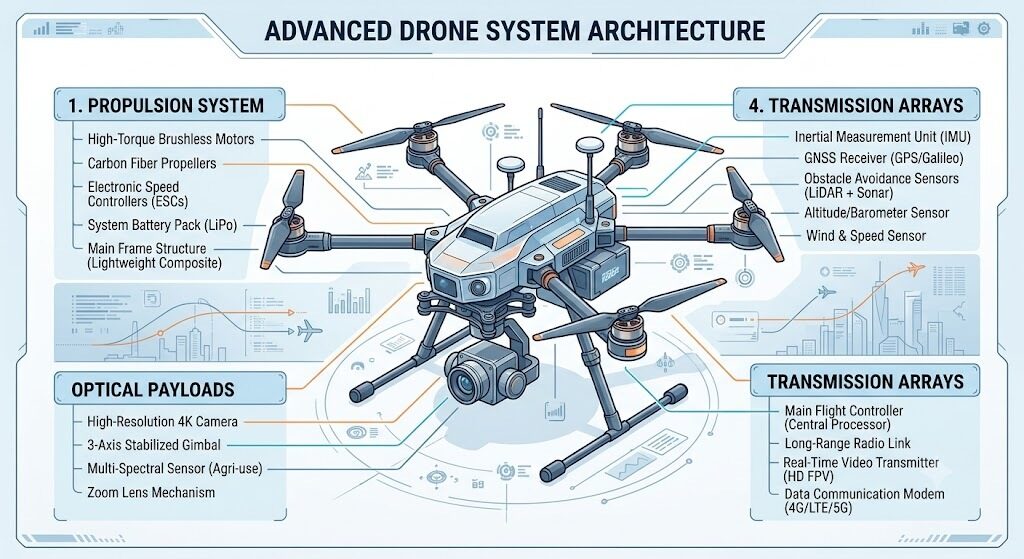
Key areas to examine include flight endurance, camera capabilities, payload limits, sensing technology, obstacle avoidance systems, and transmission range. Portability and software compatibility are equally important, as they dictate how easily the equipment integrates into your daily workflow.
When looking at manufacturer data sheets, always pay attention to drone specifications under real-world conditions rather than ideal laboratory environments. Battery life, wind resistance, and sensor performance can vary significantly depending on weather and operating altitude.
Mozello Visual Block Suggestion: Insert an annotated drone illustration highlighting major system components such as the propulsion motors, gimbal camera, obstacle-sensing modules, and GPS/transmission antennas.
Use Reviews as Supporting Evidence
No single information source gives you the complete picture of a drone's performance. Effective research combines official manufacturer documentation with independent evaluations and practical field reports.
Reading independent drone reviews helps reveal how equipment performs in day-to-day operations, highlighting potential limitations that official specifications might omit. Cross-checking multiple sources ensures that your evaluation remains balanced and objective.
Compare Options Using Consistent Criteria
When evaluating multiple UAV platforms, a structured comparison ensures you weigh options against the same operational yardstick.
| Evaluation Area | What to Consider |
| Mission Fit | Does the UAV suit the intended task? |
| Imaging | Does the camera system meet project needs? |
| Endurance | Is the operating time suitable? |
| Portability | Is transportation practical? |
| Environment | Can it operate in target conditions? |
| Workflow | Does it fit existing processes? |
| Support | Are documentation and support clear? |
When conducting a thorough
Why the Right Choice Depends on the User
Searches for the best drones often lead to lists of popular consumer or enterprise models. However, the ideal platform depends entirely on who is operating it and what they aim to achieve.
An autonomous aerial mapping mission requires entirely different hardware than a quick real estate video shoot. Prioritizing portability over payload capacity, or vice versa, depends on whether you travel frequently or operate from a fixed industrial site.
Decide Between Ownership and Professional Services
Purchasing dedicated hardware is not always the most practical approach. Investing in a professional UAV platform involves ongoing maintenance, software licensing, insurance, and regulatory compliance.
For organizations that only require aerial data occasionally, utilizing specialized drone services is often more cost-effective. Outsourcing provides immediate access to advanced equipment, trained personnel, and specialized data-processing workflows without the overhead of equipment ownership.
Finding a Suitable Drone Operator
When a project requires specialized expertise or equipment you do not own, partnering with external professionals is the logical next step. Finding qualified drone pilots near me involves examining several operational criteria:
Relevant commercial project experience
Familiarity with local airspace and regulations
Appropriate insurance and safety practices
Equipment capability matched to your deliverables
Clear communication and project scoping
Working with established operators ensures that your project is executed safely, legally, and to professional standards.
Common Professional UAV Applications
Commercial drone applications continue to expand across diverse industries, replacing traditional manual methods with rapid aerial data collection.
Aerial Media
Utilizing professional aerial photography services helps capture compelling visual perspectives for real estate marketing, tourism campaigns, structural documentation, and cinematic productions.
Surveying and Mapping
Deploying drone surveying services enables rapid land mapping, volumetric analysis for construction sites, accurate terrain modeling, and comprehensive site documentation.
Inspection
Using specialized drone inspection services allows engineers and facility managers to examine infrastructure, wind turbines, bridges, and industrial facilities without putting personnel in hazardous situations.
Agriculture
Leveraging agricultural drone services supports modern farm management through crop health observation, field monitoring, multispectral imaging, and seasonal planning.
How DronesBee.com Fits Into the Research Process
Navigating the UAV landscape can be challenging given the rapid pace of technological development. Platforms like DronesBee.com help bridge the gap between technical research and professional deployment by bringing together structured product information, reviews, comparison resources, and operator directories.
Whether you are researching hardware specifications or looking to connect with qualified service providers, having a centralized ecosystem helps streamline the journey from initial curiosity to operational success.
Simple Drone Research Workflow
A logical workflow keeps your evaluation process organized from start to finish:
Define: Outline your project goals and operational environment.
Specify: Identify necessary technical requirements and payload needs.
Research: Gather manufacturer data and documentation.
Review: Read independent field reports and user feedback.
Compare: Evaluate options using consistent performance criteria.
Verify: Check local regulations, airspace rules, and support options.
Decide: Choose between equipment ownership or professional outsourcing.
Quick Decision Checklist
Define the core project requirements and operational scope.
Identify necessary technical and environmental specifications.
Review official manufacturer documentation.
Check multiple independent information sources.
Compare suitable hardware or service options side-by-side.
Verify airspace regulations and compliance needs.
Decide whether equipment ownership or outsourcing fits best.
Evaluate professional operators if specialized services are needed.
Common Research Mistakes
Avoiding common pitfalls saves time and prevents costly mistakes during the research phase:
Choosing equipment based purely on popularity or brand name.
Focusing on a single specification while ignoring overall system limitations.
Trusting a single review without cross-checking independent feedback.
Overlooking environmental constraints like wind, temperature, and operating altitude.
Ignoring software and data-processing workflow requirements.
Assuming the most expensive model is automatically the most suitable.
Failing to evaluate professional services when expertise matters more than ownership.
Conclusion
Effective drone decisions require looking far beyond marketing claims or popular rankings. Successful deployment begins by carefully evaluating the core mission, analyzing technical requirements, examining empirical evidence, and understanding the operating environment. Whether an organization chooses to invest in equipment ownership or leverage professional services, a structured approach ensures safety, efficiency, and project success. Platforms like DronesBee.com provide valuable context by bridging the gap between equipment research and professional UAV solutions.